
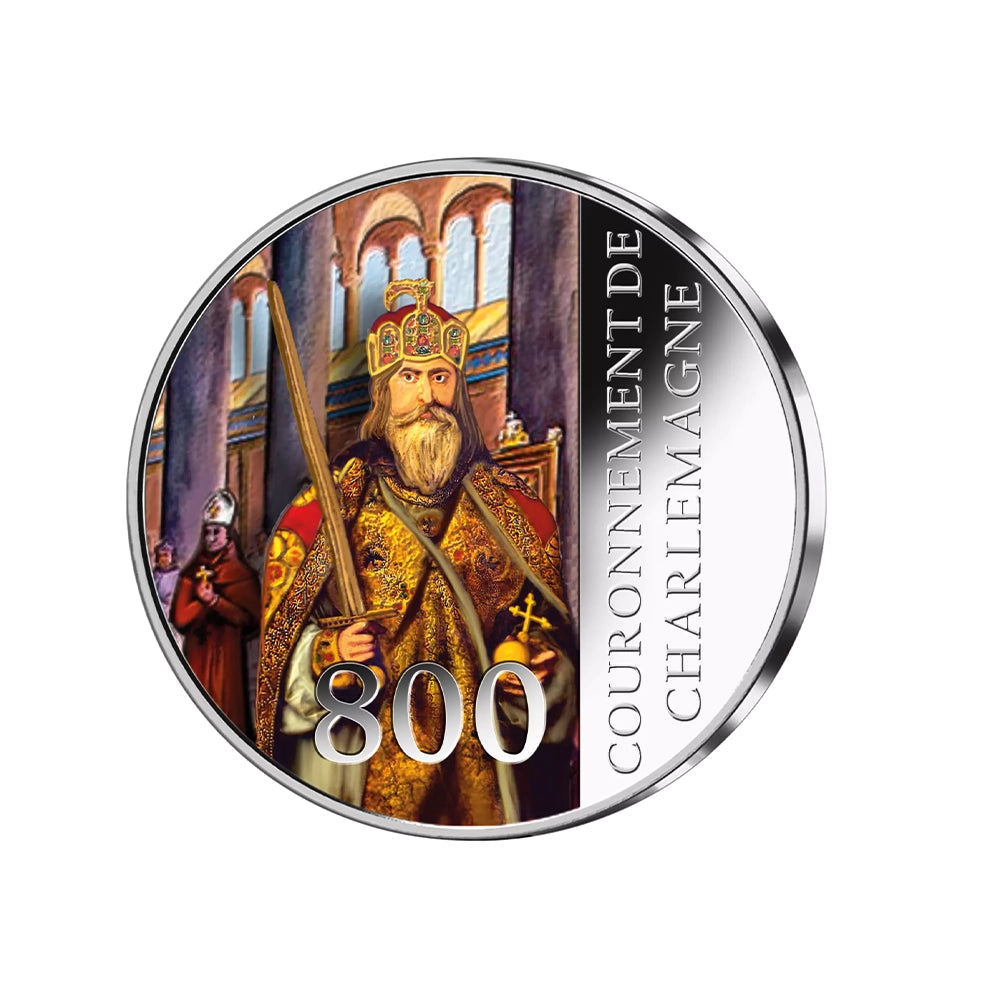
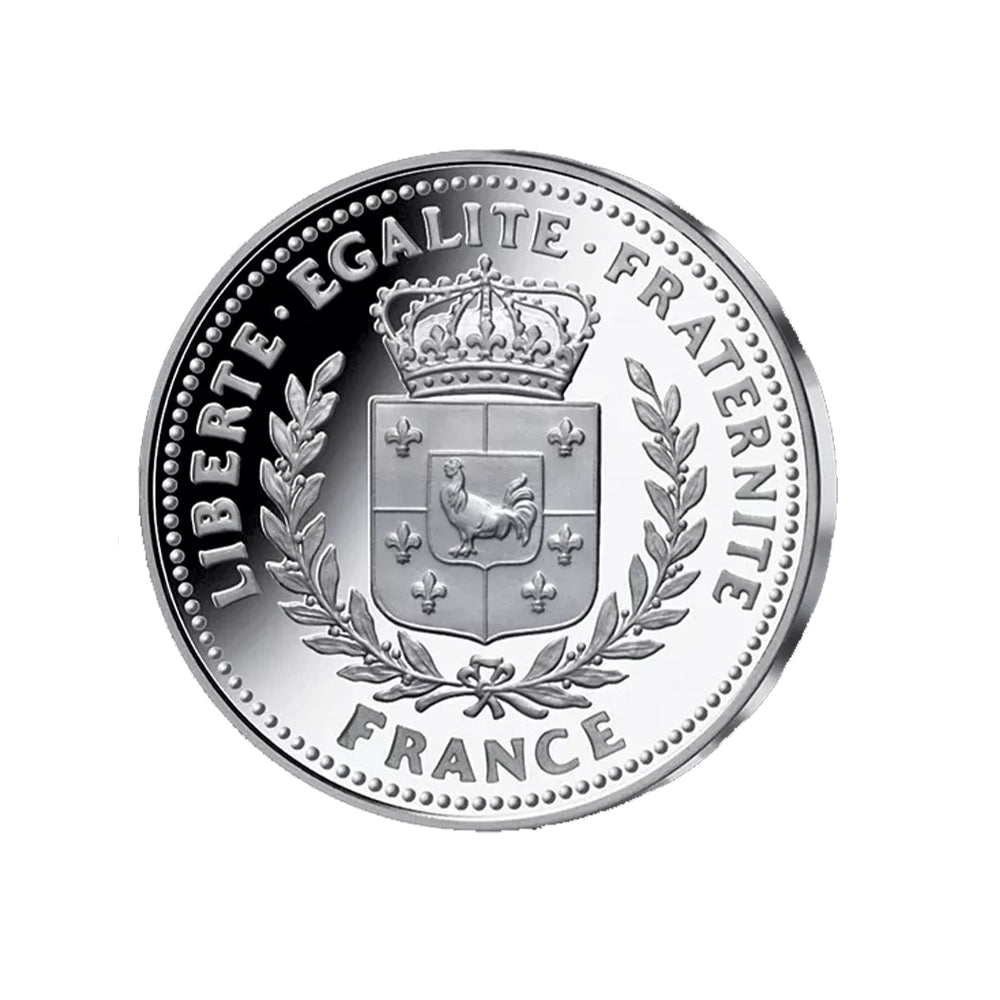


Silver Struck Coin - Coronation of Charlemagne - Year 800

Earn 0 points on this purchase.
Colorized Silver Struck Coin « Year 800, Coronation of Charlemagne»
On December 25, 800, the King of the Franks and Lombards, Charles I, known as Charlemagne, was crowned Emperor of the West by Pope Leo III in St. Peter's Basilica in Rome. He thus revived a dignity that had disappeared in Western Christendom since the deposition of the last Roman Emperor, Romulus Augustulus, in 476.
Grandson of Charles Martel, eldest son of the King of the Franks, Pepin the Short, and his wife Bertrada of Laon, Charlemagne was crowned sovereign in 768, upon his father's death. He reigned over the entire Frankish kingdom from the death of his brother Carloman I in 771. A warrior king, Charlemagne led a series of strategic military campaigns in Europe, notably against the Lombards in Italy (773-776), the pagan Saxons (776-804), and the Muslims of al-Andalus in Spain (778). Victorious, he considerably expanded his kingdom. At its peak, at the end of the 8th century, it comprised the current territories of France, Belgium, the Netherlands, Germany, Switzerland, Austria, and Slovenia, as well as half of Italy and the northern edge of the Iberian Peninsula, known as the "Spanish March." The Frankish monarchy then covered almost all of Christian Western Europe. Charlemagne is described as the Father of Europe, and his capital, Aachen, as a third Rome, after Rome and Constantinople.
The spiritual authority of the Pope in the Vatican appears weak compared to that of the Patriarch of Constantinople, who presides over the heart of the rich and powerful Christian Byzantine Empire (Eastern Roman Empire) led by Empress Irene. Rome therefore had everything to gain by relying on the Carolingian Frankish kingdom to restore its prestige. Especially since Pope Leo II, appointed in 796, suffered an attack in 799. Placing himself under Charlemagne's protection, he crowned him emperor on Christmas Day in the year 800. The Byzantine Empire initially refused to recognize the legitimacy of Charlemagne's imperial title, before accepting it in 812, with the Treaty of Aachen.
Concerned with religious unification and cultural development, Charlemagne was a fervent protector of the Church, arts, and letters in Europe. His reign marked a period of lasting cultural renewal in the Middle Ages. He surrounded himself with influential scholars at his court, developed Christian schools, and promoted the Latin language. However, his political empire did not survive him: after his death in 814, Europe would fragment under the effect of feudalism and then the emergence of nation-states.
Currency:
Country: France
Metal:
Weight: 14,6 g
Quality:
Size:
Mintage:
Face Value:
Year:
Mint: