
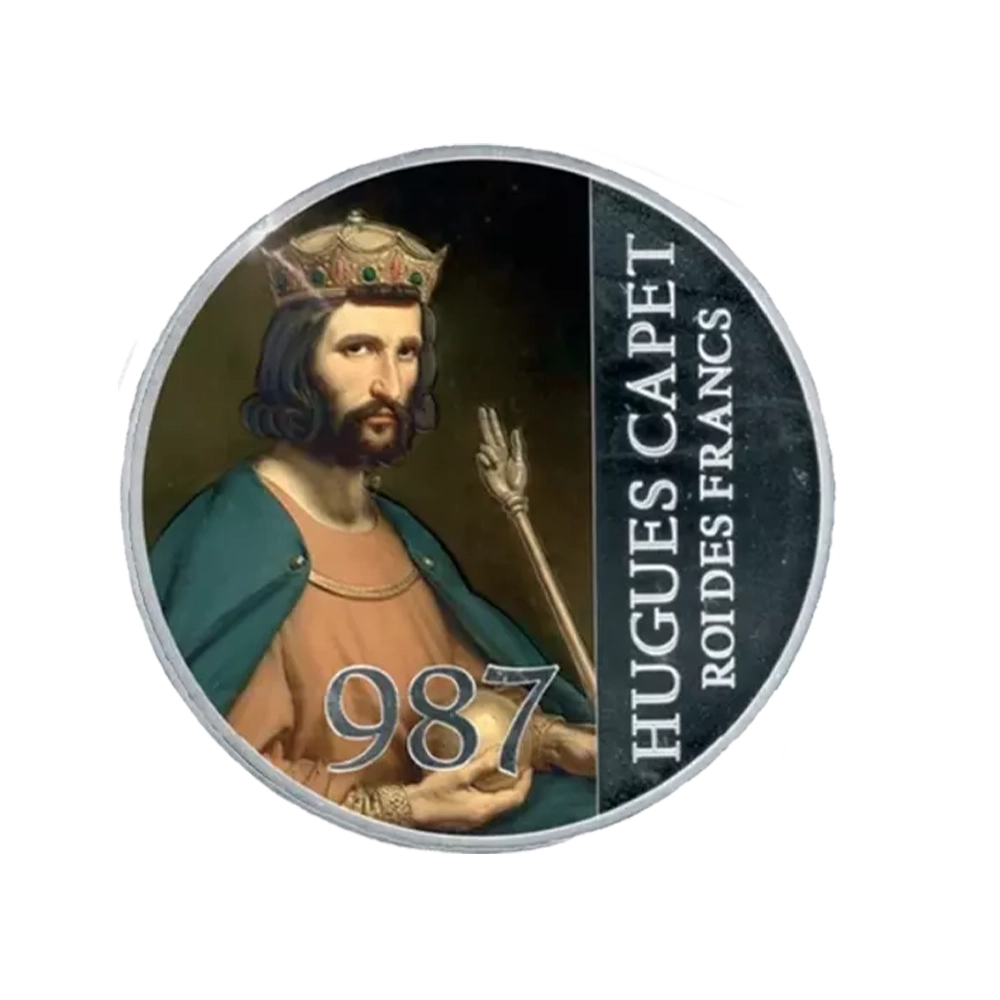





Silver Strike - Hugh Capet, King of the Franks - 987

Earn 0 points on this purchase.
July 1, 987 Hugh Capet elected King of the Franks
987. The Carolingian dynasty, brilliantly founded by Charlemagne in the year 800, had considerably weakened. Upon the death of its last representative, Louis V, known as "the Sluggard," without an heir on May 22, the assembly of the great lords of West Francia met in Senlis in June to choose a new king. On July 1, they elected Count Hugh Capet of Paris as King of the Franks. He was already a mature man for the time (47 years old). Through his father Hugh I, he was the heir to a powerful aristocratic lineage, the Robertians, who had been competing for power with the Carolingians and the Ottonians (a great Saxon noble family) for two centuries. Carolingian blood also flowed in the veins of the new king, through his grandmother Beatrice of Vermandois, a 5th-generation descendant of Charlemagne.
Two days after his election, Hugh Capet was crowned in Noyon Cathedral by the Bishop of Reims, Adalberon, according to a ritual established in 751 by Pepin the Short. Despite his election and coronation, the king would have to defend his legitimacy by force of arms. For its first two centuries, the Capetian dynasty held authority only over a limited territory, located between Paris and Orléans, with the rest of the kingdom remaining in the hands of feudal lords.
While Hugh Capet did not manage to bring his unruly vassals into line, his reign nevertheless marked a turning point for the French monarchy. By reconnecting with the Church and its most powerful bishops, and by allying with the great princes, the king strengthened his throne and devoted all his energy to creating a lasting dynasty, associating his son Robert the Pious with it from 987. He succeeded: Robert was crowned upon Hugh Capet's death in 996. Following this model, the first generations of Capetians continued to adhere to the feudal rule of election, but ensured their eldest son was elected during their lifetime. It was only two centuries later that the French monarchy, having become strong enough, could dispense with the rite of election, upon the succession of Philip Augustus on July 14, 1223. The Capetian dynasty would thus reign over France uninterruptedly until the Revolution (1792), and then from the Restoration (1815) to the end of the July Monarchy (1848).
Currency:
Country: France
Metal:
Weight: 14,6 g
Quality:
Size:
Mintage:
Face Value:
Year:
Mint: